
What is a Clear Mind?
Meditation and the brain's signal-to-noise ratio


the beginners mind
is naive and wise
and emptiness
is active—
the serene water receives
and ripples in all directions
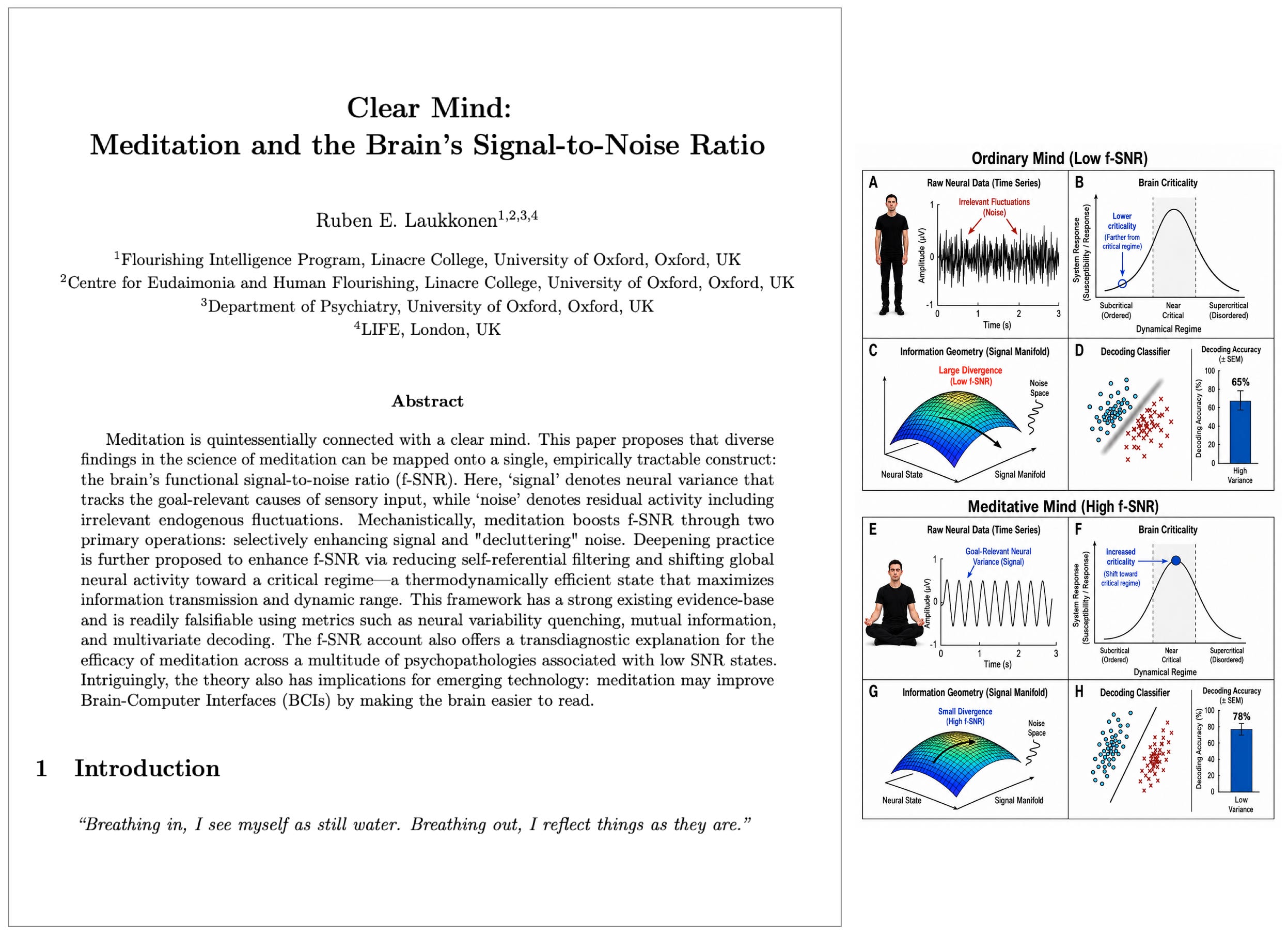
I’ve been incubating on this for about five years. It all began when I measured my own brain during my postdoc in 2021. I was setting up a decoding pipeline for an EEG (electroencephalography) experiment, which was working extraordinarily well. On my brain, I could decode sounds from EEG activity near ceiling (~0.9 AUC). But then, when I ran the same experiment on other participants, the best I got was an AUC of 0.62. Why that happened haunted me for years, literally.
Then one day, I realized what the difference was. The difference was that, during data collection, I was meditating. Because that was something I just naturally did when sitting still and listening to sounds. I was intently focused on the sounds I was hearing, with an otherwise empty mind. So my brain was also focused and clear. And therefore, easy to decode.
It’s pretty obvious in hindsight.
So when I tested the idea on some existing preliminary data, low and behold, participants during meditation showed better sound decoding than participants not. Now I just needed to figure out the mechanism and run a hypothesis-driven experiment.
But how does meditation translate to clearer neural signals?
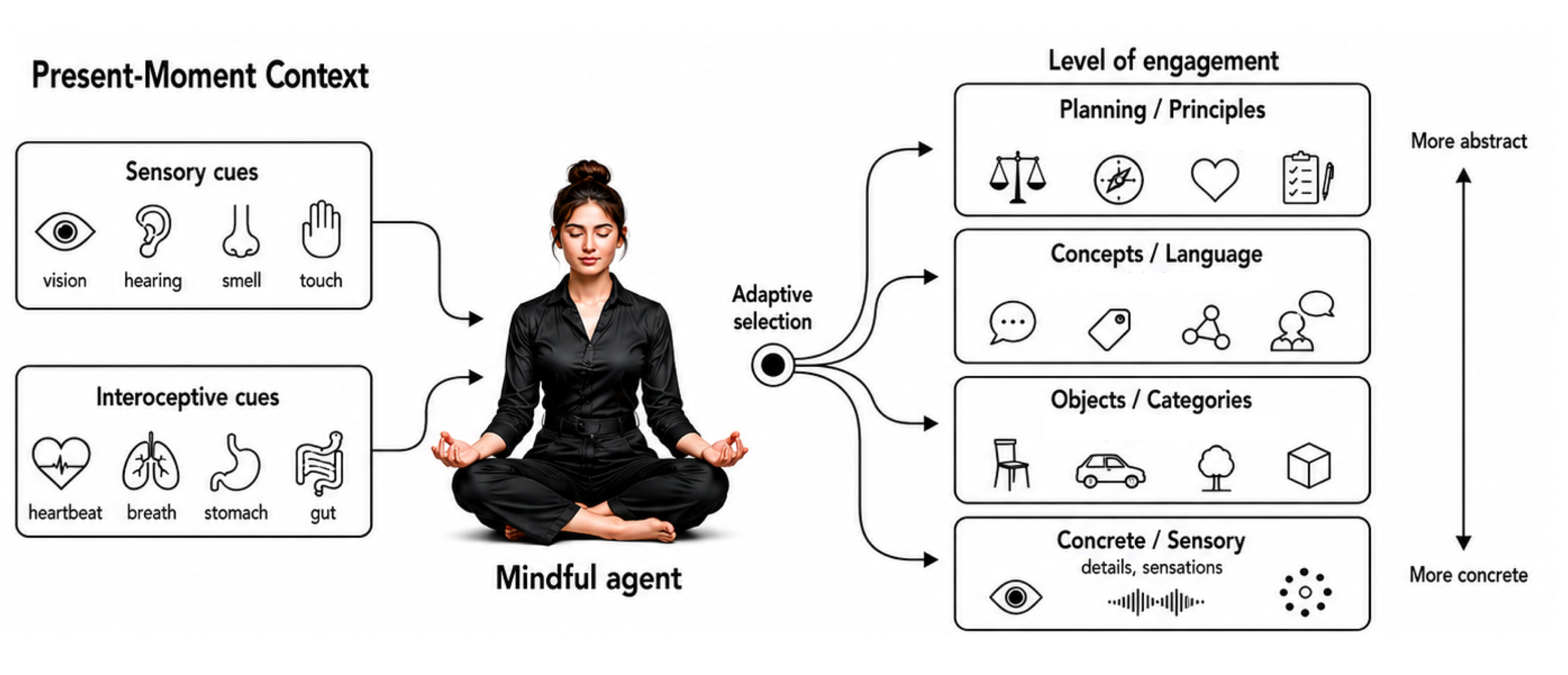
Well, think about how any basic meditation practice works. You selectively enhance some aspect of experience (i.e., signal), be it your breath, a mantra, the body, or awareness itself. You also selectively declutter or “let go” some other aspect, such as self-centred rumination and other pointless neuroses (i.e., noise).
You enhance a present-moment signal and you release the noise.
So a clear mind ought to be reflected in the brain’s signal to noise ratio and this makes the brain more decodable! If your intentions are clear; so is your brain. It better tracks the input. It better mirrors the world.
https://arxiv.org/pdf/2606.29698
The implications are fascinating.
One surprising consequence is that the future of brain-interfaces might depend on the capacity to meditate. Because you can’t decode a brain that’s noisy. So being able to control machines with your mind might one day depend on your capacity to enact a clear mind.
Another implication relates to our understanding of psychopathology. One of the most cited papers in the field famously criticized meditation for claiming to be a panacea. And yet, there is reason to believe that meditation is at least panacea-like, given it’s unusually broad applications for psychopathology and beyond.
Why is that?
Well, according to the present theory, the reason meditation is so generalizable is because many psychopathologies can be linked to poor neural f-SNR (think, obsessions, depressive rumination, anxious worrying, delusional thinking, etc.).
Most of the things we suffer is a consequence of us losing touch with the signal manifold. We get absorbed in our self-generated ignorance; lost in the endogenous noise of our own creation. The second arrow ensues.
If we learn to practice mindfulness, for example, we begin to be able to agentically select how much abstraction is appropriate for the moment. We begin to be able to skilfully traverse the hierarchy of the mind according to the demands of the present; letting go activity that hinders our ability to see clearly.
Or, as my boy Bruce Lee put it:
“Be like water making its way through cracks. Do not be assertive, but adjust to the object, and you shall find a way around or through it. If nothing within you stays rigid, outward things will disclose themselves. Empty your mind, be formless. Shapeless, like water. If you put water into a cup, it becomes the cup. You put water into a bottle and it becomes the bottle. You put it in a teapot, it becomes the teapot. Now, water can flow or it can crash. Be water, my friend.”
But what about deeper insights?
The more advanced practices and realizations we encounter in meditation can be framed as removing pervasive channels of noise driven by aberrant priors, e.g., those comprising a rigid self-model.
There are entrenched habits in our minds that consistently warp our more direct experience with layers and layers of confusion. Potentially, unraveling these maladaptive priors through insight is like wiping a thick layer of grime from a mirror that has quietly distorted every reflection, allowing the whole field of experience to become clearer at once.
Perhaps, then, awakening is a dramatic change in the generative model; a revision of a mutually reinforcing collection of maladaptive priors; that leads to a non-linear boost in the brain’s signal-to-noise. This would go a long way in explaining the profound clarity that accompanies such shifts.
“Breathing in, I see myself as still water. Breathing out, I reflect things as they are.” — Thich Nhat Hanh
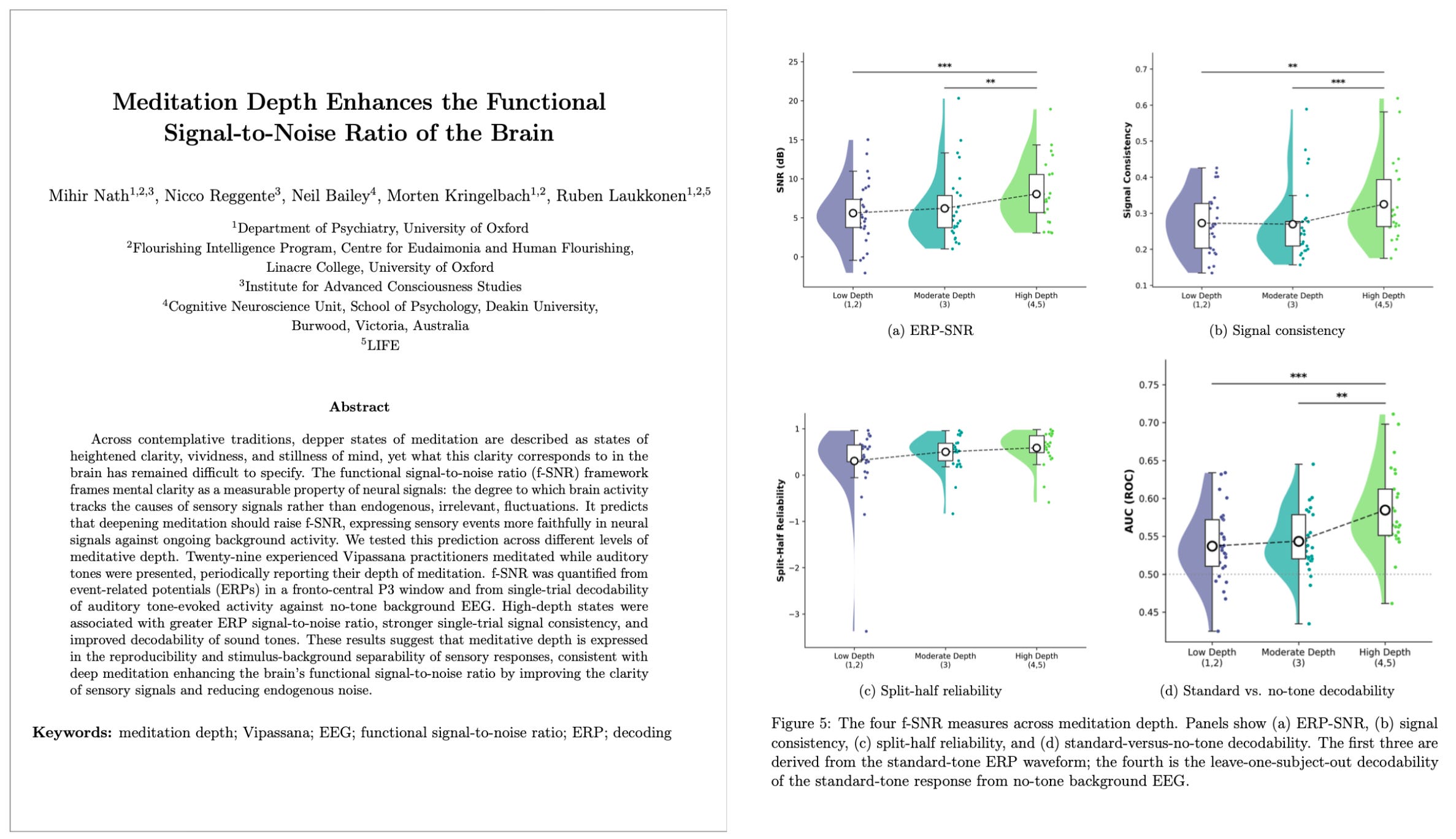
The paper also provides extensive tools for objectively measuring a clear mind. The brain’s f-SNR, purely from a methodological angle and as a useful outcome variable, is something largely ignored. Indeed, our second empirical paper already shows strong evidence that the SNR indicators reflect meditation depth better than both traditional linear and non-linear metrics.
https://www.biorxiv.org/content/10.64898/2026.06.30.735351v1
Special thanks to Mihir Nath for spearheading the empirical test.
And here’s a really cool bonus finding:
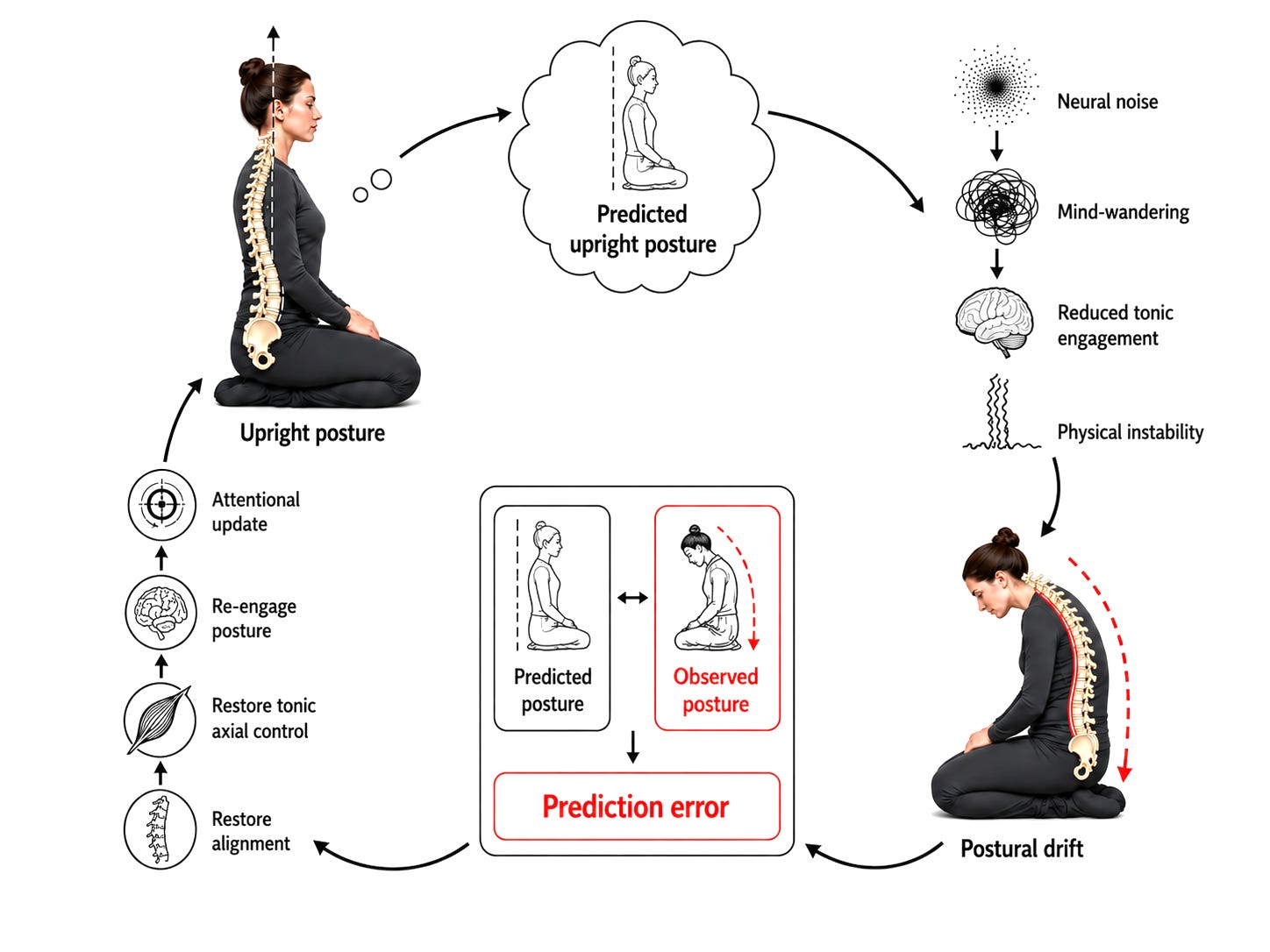
The meditative posture may act as a kind of inner neurofeedback device. The careful posture we maintain during meditation enacts a sensorimotor error-correction loop, signalling through prediction errors when the mind fails to track the present moment. A slumping posture reveals you’re in noisy territory (e.g., mindwandering), alerting the mind to return to the signal when bodily alignment falters.
Much love,
Ruben
Ps - As always, maps are just maps.
Ruben, your posts are always insightful and enjoyable, thank you
Thank you for an excellent and clear explanation. As an unscientifically minded meditator, this bridges my gap perfectly. Hope you are well and happy!
PS PM'd you